
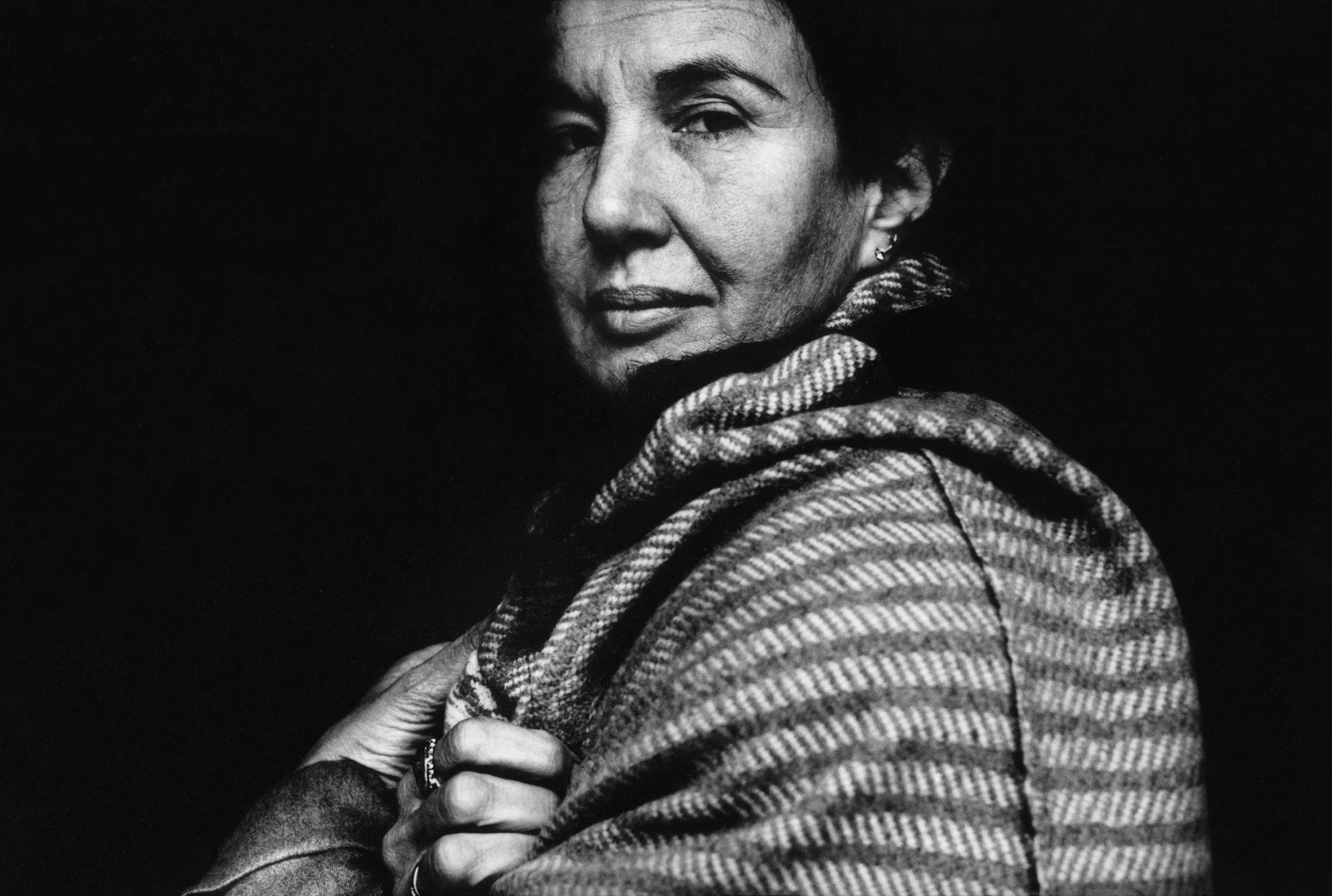
The contrast between her photographs, which feel engaging and vulnerable, and her in-person presence, which was cautious and guarded, was interesting. It made the photo session and the interview unsatisfying, but also struck me that she was a fascinating enigma as an artist.
I'm grateful my college hosted a visiting artist series. Looking back, the lineup was extraordinary: Danny Lyon, Susan Meiselas, Frederick Sommer, Duane Michals, Joel-Peter Witkin, Hiro, Arnold Newman, and many others. One visit I was determined not to waste was Mary Ellen Mark's, in the fall of 1988.
I'd been out of school for over a year, but the lectures were open to the public. I pitched a profile of Mark to Toronto Life, hoping to photograph one of my heroes while she was in town. My enthusiasm apparently convinced the editors, because they assigned me not only the portrait but the interview as well.
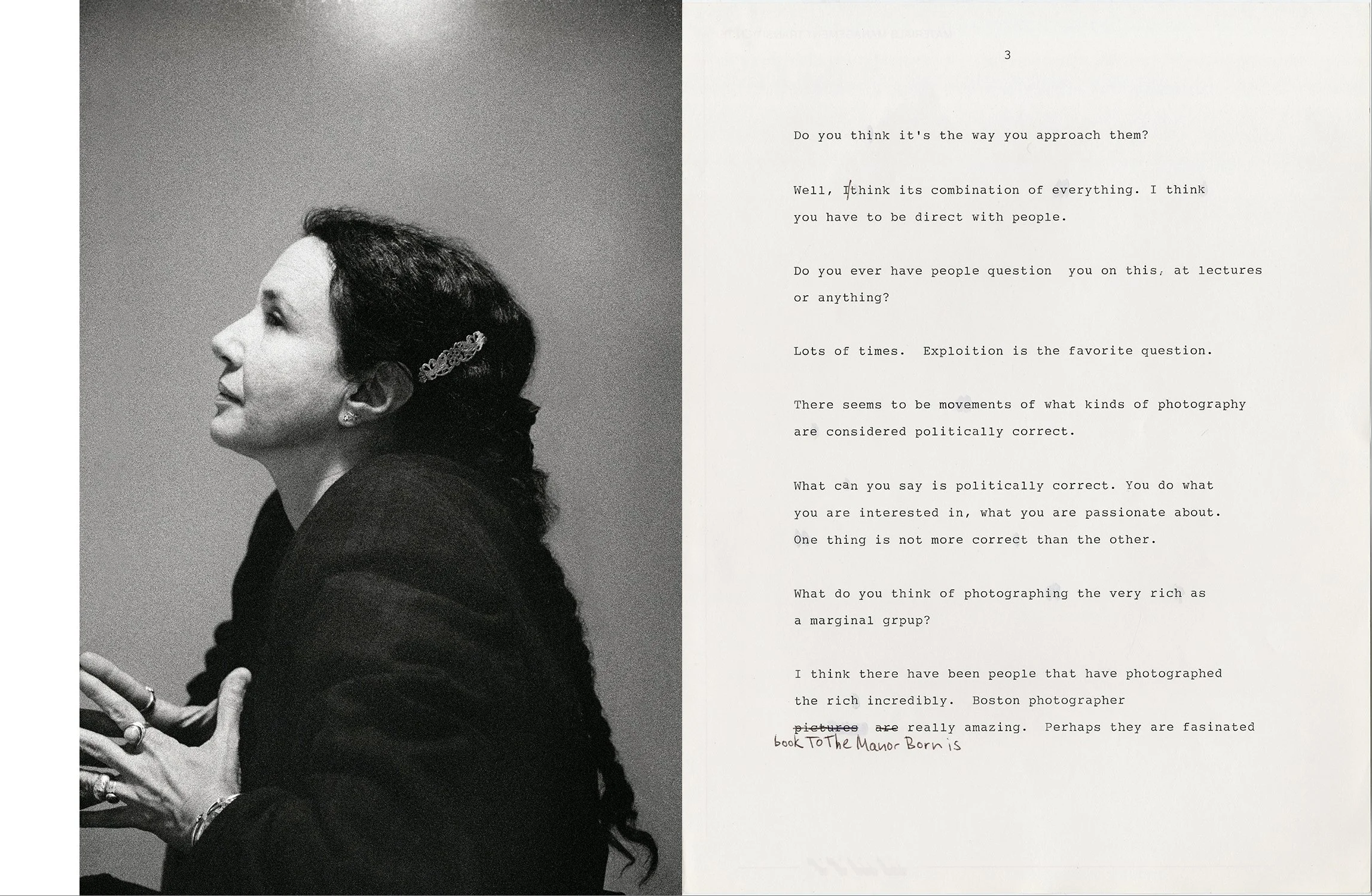
I attended her lecture and sat in on several student critiques she led at Ryerson. She was generous with her time, allowing me to photograph her both inside the school and around the neighborhood.
I had the chance to interview her in person, but struggled to get meaningful answers out of her. Her work was so powerful, in both her subject matter and her visual storytelling, yet she struck me as closed and difficult to connect with. We never found much of a rhythm, although she did agree to continue the interview by phone after returning to New York.
Somehow I also ended up driving her to the airport.
In retrospect, it's a ridiculous scenario. I was a young photographer and a relatively new driver, chauffeuring one of the giants of photography.
At one point I needed to cut across several lanes of traffic in quick succession and announced my intentions aloud as I went. Mark, understandably alarmed, said, "It's all right. We can drive around again."
"No, I've got this."
I made the exit, but to this day I occasionally wonder whether I almost killed Mary Ellen Mark on the way to the airport.
***
Do you show your work to your subjects?
I try and show my work to my subjects afterwards, but when you are travelling places that are very, very far away, you can't always get to them. I try and send magazines to make sure they see them published.
How do they usually respond?
Well, luckily… I mean, I guess it's not luck because I don't think I have ever done any pictures that have hurt anybody but I've never had a really negative response.
Are they ever surprised by the pictures you take of them? Can you think of any specific reactions?
I think when people who normally aren't famous get published in magazines, they don't take it for granted; their reaction is always very different from those that are well known and are published in magazines a lot. To them, it's not such a big deal, but the others, when someone recognizes them from a magazine, they sort of don't believe it's happening.
At some point you must have had to justify yourself why you are doing this work and if it fair to the people you photograph?
Why is it more fair to a rock star to take his picture and publish it in a magazine than it is to someone struggling on the edges of our society? Why does he deserve to be recognized and made known more than someone who is having a tougher time in life? Why should they just be ignored? The role of the social documentary photographer is maybe to bring things to people's
attention they normally wouldn't look at or think about.
Have you ever had subjects or possible subjects confront you with that? “Why should I help you? What are you going to do for me? Why should I do this?”
Actually, I have to tell you that that's never happened. It's more the famous people that react like that. Like “why should I help you, what's in it for me?” But usually with other people that aren't so exposed to the media, you won't get that reaction. They are just surprised, maybe at first, that you are interested in their lives at all.
Do you think it's the way you approach them?
Well, I think it’s a combination of everything. I think you have to be direct with people.
Do you ever have people question you on this, at lectures or anything?
Lots of times. Exploitation is the favorite question.
There seem to be movements of what kinds of photography are considered politically correct.
What can you say is politically correct? You do what you are interested in, what you are passionate about. One thing is not more correct than the other.
What do you think of photographing the very rich as a marginal group?
I think there have been people that have photographed the rich incredibly. Mary Lloyd Estrin’s book To The Manor Born is really amazing. Perhaps they are fascinated by what advantage brings the way I am of those who lack those advantages. I think it would be interesting to photograph the rich, I've never really done it in black-and-white and in a way I would like to but I think that, sure, it would be interesting.
Would they be harder to gain access to?
With someone like Helmut Newton, he's photographed so many of the privileged; he's obsessed with it, therefore he knows who to gain access to it. It certainly would be interesting to try because they are a fringe group also. But again, like celebrities, there is the problem that they are over-photographed. It's really difficult to see the real person, you're dealing with someone who understands how to manipulate the media. I like people that are as pure and direct with me as I try to be with them.
When you are in the middle of an extensive project, how does it affect you?
I can't sleep at night, my brain working with what I experienced during the day. And I can't wait to get back to the situation, that's when I know I'm involved with something that's working.
Do you have any hobbies?
Yeah, photography. No, actually I like antiques, I like Indian Art, Indian antiques. For years I've shipped things back, so now my place is full of these incredible strange objects: Ganesh, metal cows, reverse glass paintings.
Which photographers have influenced you?
When I began to photograph the people whose work I looked at were Henri Cartier-Bresson, Robert Frank, and Diane Arbus, but I also looked at pictures by people like Steichen because he did incredible portraits, I think Avedon is really interesting in that area as well. But you want to do your own work, so at this point it's more being inspired by rather than influenced by looking at other people.
Do you feel you are working in a particular tradition?
I suppose you could say it's documentary, it's realistic - not conceptual. What's most important to me isn't the photo essay as an essay but each picture being able to stand up on its own as a strong image.
I'm going to go so far as to say that I see your photographs as almost romantic in the way they
see people.
I don't like overly romantic images, but I don't want to make people throw up either. I care about the people I photograph, so I want to see them in a…not romantic light…but in a strong…an image that people will want to look at. I don't know, romantic isn't really…because I don't think there is anything romantic about poverty, it's horrible, or romantic about illness, it's horrible. I don't want people to look at people that are poor or ill and say “God! That's discusting!” So I think there is some middle ground that you reach.
How do you approach commercially oriented commissioned work?
When I accept any job or assignment, I work very, very hard and I do the best that I can. It's different from my usual work but if I'm going to accept it I'll put an incredible effort into it because it's a real responsibility. The end result is that it helps finance my other projects. I'm doing an ad campaign for Good Housekeeping magazine, its advertizing and therefore has different demands but it's portraits of real people, so at least that much is connected with my
work.
The A Day In A Life book series approach to photo documentary has been described as a “shoot and run” process by some critics. As someone who is known to spend weeks working with a subject how did you feel about participating in the series?
People are very quick to criticize something successful. In a way, it's a very good discipline. But they do give you a few days to research it and you also have a chance to choose the areas you're interested in. I'm very positive about the Day In A Life. They have done a tremendous amount to help and promote young photographers and out of each of these projects I've come out with some good pictures for myself.
Do you think that there is something special about the way you approach people that they allow you to photograph them?
There are no formulas or answers and I can't really say “you do it this way” because each time is different and everything changes. What I think is very important is to be clear and sure of what you want to do, if you are insecure about it people sense that. It's that old story that if you're walking down the street looking paranoid and scared you are going to get mugged. I think it's the same thing when you are taking pictures, if you seem embarrassed or ashamed, people are going to pick up on that and they are not going to want you photographing them.
An additional note: Revisiting the transcript of our interview 38 years later, it strikes me that my questions could have been more appreciative to her work and contribution, rather than immediately pressing for inconsistencies and missteps. It is an interviewer’s job to challenge a subject, but I likely would have gotten more out of Mary Ellen Mark with honey than vinegar.
Top Image: Mary Ellen Mark, photographed in a Toronto doorway, November 11, 1988.
Bottom Images: Left: Mark in the Photo Arts Ryerson basement. Right: A page of the interview transcript.